
The Quiet Architecture of Your Morning Beverage
Your coffee isn't just coffee.
(I mean, it is. But also it's not.)
When you work from home, that first cup in the morning becomes something else entirely—a structural beam holding up the day, a ritual that marks the transition from "person in pajamas" to "person attempting to function," a tiny ceremony you perform before opening your laptop and remembering everything you're supposed to be doing.
For reasons I don't fully understand, what you drink and how you drink it matters more when there's no commute to separate home-you from work-you. The beverage becomes the boundary.
The Thing No One Mentions About Working From Home
When you work in an office, the day has scaffolding built into it. You leave your house. You arrive somewhere. You sit at a desk that is not your couch. Your brain registers these transitions and responds accordingly.
When you work from home, you have to build all of that yourself. And most of us do it—consciously or not—with what we drink.
The morning coffee ritual. The mid-afternoon tea that signals a reset. The specific mug that means "I am working now, not just existing in my house wearing yesterday's sweatpants."
(Though to be clear, the sweatpants are staying. This isn't about performance. It's about clarity.)
A Tiny Theory About Beverages and Brain States
Your brain loves patterns. It's constantly looking for cues about what mode to be in, what to expect, how to orient itself in time and space.
When you pour the same coffee every morning, sit in the same spot, hold the same warm mug—your brain starts to associate that entire sensory experience with "work mode" or "focused morning" or "the part of the day when I can actually think."
The beverage becomes an anchor.
And here's the interesting part: changing the beverage can change the anchor. A different coffee can make your morning feel subtly different. A new tea can turn your afternoon slump into something that feels more like an intentional pause than a slow collapse into exhaustion.
This is not about optimizing your productivity. (We don't do that here.) This is about creating small moments of difference in days that can start to blur together when your bedroom, your office, and your kitchen are all the same place.
When Sameness Becomes Static
There's a specific kind of flatness that sets in when you work from home for long enough. Not burnout, exactly. More like... sameness fatigue.
Every day starts the same. The same desk. The same chair. The same kitchen. The same coffee from the same bag you bought three weeks ago and will probably finish three weeks from now.
And somewhere in month six (or twelve, or twenty-four), you realize your brain has started treating every day like it's the same day, which makes it very hard to tell if you're making progress or just treading water in sweatpants.
One surprisingly effective remedy: change what you're drinking.
Not forever. Not drastically. Just... differently.
The Case for Beverage Rotation
If you're the kind of person who buys the same coffee every time because "you know what you like" (deeply relatable), consider this: your brain might be starving for novelty.
Not the kind of novelty that requires you to reorganize your entire life or book a flight somewhere. Just the small, manageable kind that shows up in a different flavor, a different ritual, a slightly different version of your morning.
Here's what a coffee subscription actually does for your brain:
It removes the decision fatigue of "what should I buy this time" (because the decision is already made—whatever shows up is what you drink). It introduces gentle novelty without requiring you to become a coffee expert or spend forty-five minutes at the store reading labels. And it creates a small moment of anticipation each month—something to look forward to that isn't work-related or anxiety-inducing.
Atlas Coffee Club sends you coffees from different countries every month—Ethiopia, Colombia, Brazil, Guatemala. Each bag comes with tasting notes and a postcard about the origin. It's like traveling without leaving your kitchen, which sounds like marketing copy but is actually just... true. Your Tuesday morning in front of your laptop tastes like something from Kenya. Your brain notices.

And if you're more of a tea person:
Tea does something different. Coffee is the alarm clock. Tea is the reset button.
Mid-afternoon, when your focus has dissolved, and you're debating whether to push through or surrender to the couch, a good tea can split the difference. It's a pause that doesn't feel like giving up. It's warm, it's ritual, it's permission to stop for ten minutes without guilt.
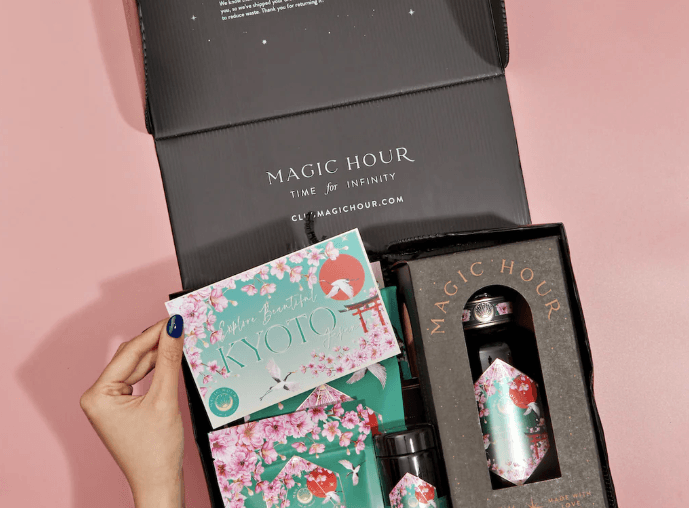
Magic Hour is a tea subscription that sends you a curated box of organic, small-batch teas. Loose leaf, so the ritual of making it feels intentional. Different flavors to match your mood or the season, or whatever your brain needs that day. Each blend is thoughtfully crafted, which sounds like marketing speak but actually just means: someone cared about what they were making.
The point isn't to collect beverages. The point is to give your brain something to notice. To mark time in small, pleasant ways. To make Tuesday feel different from Wednesday, even when both days involve the same desk and the same screen and the same vague sense that you should probably be further along than you are.
What This Actually Looks Like
Practically speaking, it looks like this:
You wake up. You make coffee. But instead of the same coffee you've been drinking since February, it's something new. Ethiopian Yirgacheffe, maybe. Or a medium roast from Costa Rica that has notes of chocolate and caramel (or so the bag claims—you mostly just taste "good coffee," but the description matters anyway).
Your brain registers: This is different.
Not life-changing different. Just... present. Awake to the moment. Briefly interested in something other than the to-do list.
Later, mid-afternoon, when the focus has worn of, and you're considering a nap or a walk or just staring at the wall, you make tea instead. A green tea with jasmine. Or a rooibos blend that tastes vaguely like dessert. You sit with it for ten minutes. You do nothing else.
(This is harder than it sounds, doing nothing else. But it's the whole point.)
Your brain gets a reset. Not because the tea is magic, but because you paused, held something warm, and gave yourself permission to not be productive for 600 seconds.
The day continues. But it continues differently.
The Ritual Is the Structure
When people talk about "self-care" or "work-life balance" (phrases we mostly avoid here because they've been beaten into meaninglessness), they usually mean big interventions. Take a vacation. Set boundaries. Completely restructure your relationship with work.
All of which is fine advice. Hard to execute, but fine.
Here's the smaller truth: most days don't need a complete restructure. They need a few reliable anchors.
A morning ritual that signals "the day has started."
An afternoon pause that signals "I am allowed to stop for a moment."
An evening boundary that signals "work is over now, even though I'm still in the same building."
Beverages can be all of these things. Not because they're special, but because you make them the marker. The punctuation in your day. The thing that separates one section from another when the physical space refuses to do it for you.
What You Don't Need
ou don't need the perfect coffee. Or the perfect tea. Or the perfect French press or pour-over setup or temperature-controlled kettle.
(Though if those things bring you joy, by all means. We're not anti-gear. We're just anti-requirement.)
You also don't need to become a beverage person. You don't need to learn cupping notes or develop opinions about water temperature or understand the difference between Darjeeling and Assam.
You just need something warm to hold. Something that tastes good. Something that gives your morning a shape and your afternoon a pause.
The rest is optional.
A Small Suggestion
If you've been drinking the same coffee or tea for months (or years), and your days have started to feel like one long continuous loop with no clear beginnings or endings, try changing it.
Not your whole routine. Not your entire setup. Just the beverage.
Get a subscription that sends you something different each month. Or go to a coffee shop you've never been to and buy whatever's local. Or ask someone you trust what they drink and try that.
The goal isn't novelty for its own sake. The goal is to give your brain a small signal that today is not exactly the same as yesterday, even when it mostly is.
Because when you work from home, sameness is the default. And your brain—smart, scattered, surprisingly functional—deserves a few anchors to hold onto. A few small rituals that mark time and create structure in a day that otherwise threatens to dissolve into one endless, vaguely productive blur.
Coffee can be one of those anchors. Tea can be another.
Not because they're magic. But because you decide they are.
Things That Help
For Coffee People:
Atlas Coffee Club — Monthly coffee subscription featuring single-origin beans from around the world. Whole bean or ground. Light, medium, or dark roast. Each bag includes tasting notes and origin story. Basically, your morning routine gets a passport.
For Tea People:
Magic Hour — Organic, small-batch tea subscription featuring thoughtfully crafted loose leaf blends. Each box is curated for the season or theme, so you're not just getting tea—you're getting an intentional experience. The kind of ritual that makes your afternoon pause feel less like procrastination and more like self-preservation.
Also Worth Considering:
A good mug. Not fancy. Just one that feels right in your hand and makes the whole experience slightly better. The ritual only works if the details feel good.
A timer. Set it for ten minutes when you make your afternoon tea and actually sit with it. No phone. No laptop. Just you and the tea and permission to do nothing else.
A final thought:
Your morning coffee or afternoon tea won't fix your life. It won't make you more productive or more focused or more successful.
But it might make today feel like today instead of just another Tuesday that looks exactly like last Tuesday and the Tuesday before that.
And when you work from home, that small difference—between days that blur together and days that feel distinct—might be exactly what you need.

About Those Links
Some links here are affiliate links—if you buy something, we might earn a small commission. We only recommend things we'd actually tell a friend about. You're not obligated to click anything, but if you do, it helps keep this place going. Thanks for being here.
Did you like this article? Spread the word!


Smart stuff, occasionally.

A blog that helps you think better, get things done, and stay mostly sane.
Solutions
Clear Thinking
Mental clarity for overthinking minds
Getting things done without losing yourself
Desk setups, organization, cozy tools
Curated products worth your attention